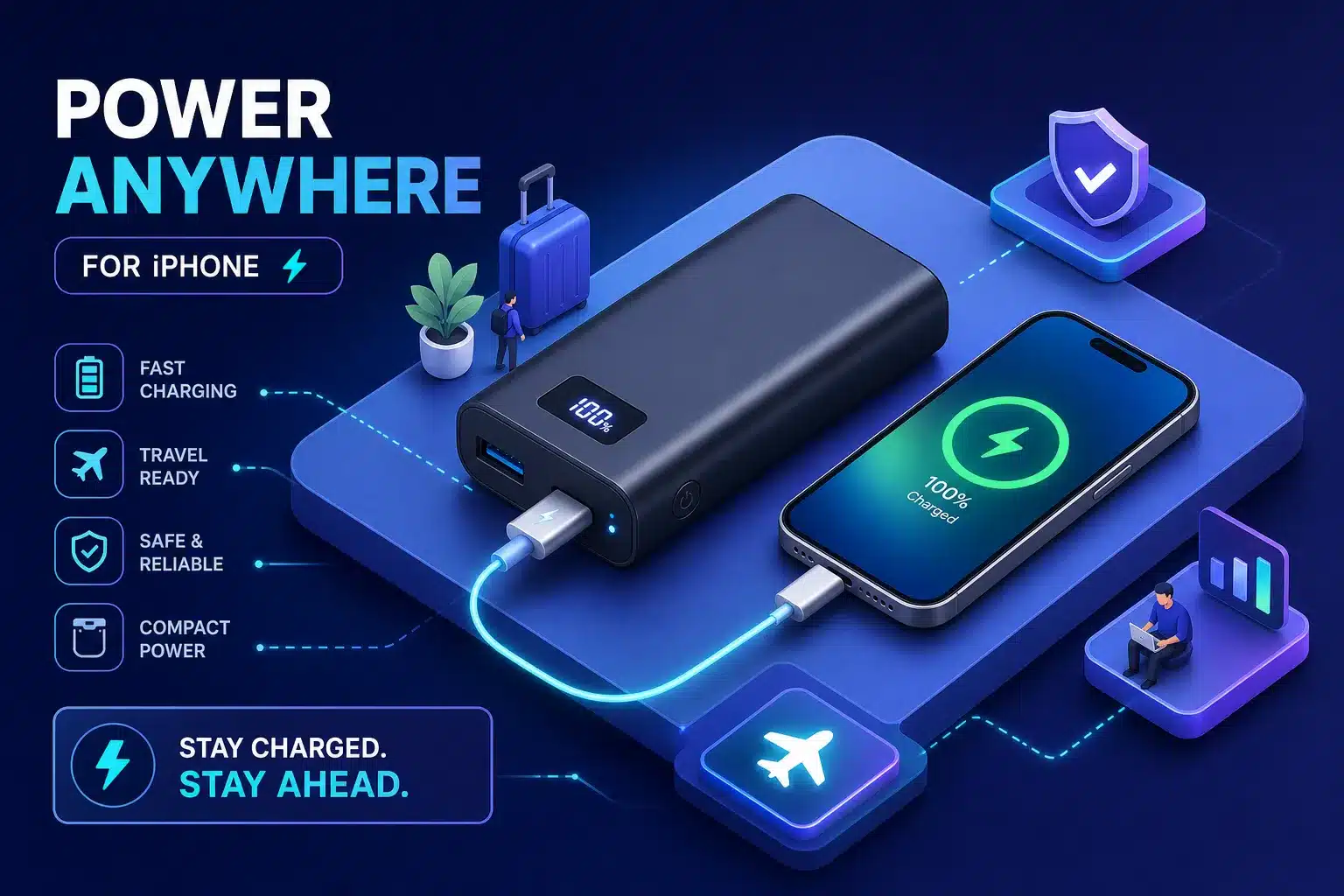
Your iPhone hits 4% battery at the exact worst moment: boarding a flight, navigating an unfamiliar city, wrapping up a work call. The right portable charger for iPhone fixes that problem reliably, but only if you buy the right one. The wrong pick sits in a drawer because it’s too slow, too bulky, or simply can’t keep up with a Pro Max.
This guide cuts through the noise. You’ll learn the three specs that actually matter, how to match capacity to your real charging needs, and when to choose MagSafe over a cable. Then you’ll get four specific picks for 2026, organized by use case so you can find your match in under two minutes. And if you want to skip the retail markup entirely, Gskbuy carries top-rated portable chargers at steep discounts, more on that at the end.
Most people shop power banks by glancing at mAh and price, then wondering why their expensive charger barely keeps up. Three numbers determine whether a power bank fits your life: capacity, output wattage, and connection type. Understanding each one takes less than five minutes and saves you from a $50 mistake.
Milliamp-hours measure how much energy a power bank stores, not how quickly it charges your phone. The critical caveat: real-world output is only about 60 to 65% of the rated capacity. Voltage conversion and heat loss eat the rest. A labeled 10,000mAh bank delivers roughly 6,200mAh of usable energy to your iPhone, not the full 10,000. Factor that in before comparing sizes.
iPhones fast charge via USB-C Power Delivery, and 20W is where meaningful speed begins. Anything below 18W won’t meet Apple’s defined fast-charge rate. Going above 20W (say, 30W or 45W) won’t meaningfully speed up most iPhones, standard models cap their own input around 20W, though some recent Pro models can accept higher wired wattage and see modest gains. More importantly, higher output future-proofs the charger for iPads, laptops, and whatever comes next. Cable choice matters too: USB-C to USB-C for iPhone 15 and later, USB-C to Lightning for older models.
Not all wireless chargers are equal. Generic “MagSafe-compatible” claims typically cap at 7.5W. Qi2-certified power banks deliver 15W wireless charging for iPhone 12 through 16. Qi2.2-certified models unlock up to 25W for iPhone 17. If you’re doing overnight charging and aren’t in a rush, non-certified is fine. For mid-day top-ups where time matters, certification is non-negotiable.
Bigger isn’t always better. A 20,000mAh brick in your jeans pocket isn’t convenient, it’s a chore. The right capacity matches your iPhone model and daily habits, not your anxiety about running out of power. Here’s how to think about each tier.
This is the commuter’s option: thin, light, and purpose-built for one emergency top-up. After accounting for efficiency losses, a 5,000mAh bank delivers around 3,100mAh of actual charge. That falls short of a full charge for most standard iPhone 17 models, which carry batteries in the 3,500 to 3,700mAh range, and covers roughly 60% for a Pro Max. The payoff is a profile thin enough to share a pocket with your keys.
This is the ideal tier for most users, and it’s not close. Effective output lands around 6,200mAh, which translates to 1.7 to 2 full charges for standard iPhones and 1.2 to 1.5 charges for the Pro Max. It’s small enough for a bag, capable enough for a full day plus overnight backup, and it’s the tier where the best MagSafe options live. If you’re buying one power bank and keeping it for the long haul, this is the one.
A 20,000mAh external battery pack provides 3 to 4 full iPhone charges and doubles as a backup for an Apple Watch or iPad on longer trips. The trade-off is real: heavier, bulkier, and you’ll want to confirm it clears airline watt-hour limits before packing it (covered in the travel section below). For daily carry around town, this size is overkill for most people.
This is the decision most buyers overthink, both approaches work, and it comes down to which trade-offs you’re willing to live with every day.
A Qi2-certified MagSafe power bank snaps onto the back of your iPhone magnetically, requires zero cable management, and keeps the phone usable while it charges. iPhone 12 through 16 users get 15W wireless; iPhone 17 owners paired with a Qi2.2-certified bank can see up to 25W. In real-world terms, that’s roughly 45 minutes to reach 60% on an iPhone 15 at 15W. The magnetic connection on most certified models is strong enough to stay put in a bag or while you hold the phone normally during typical use.
A cable-based portable charger delivers 20W to 45W, which beats every wireless option on raw speed. It also tends to cost noticeably less than a comparable MagSafe bank and works with any iPhone regardless of magnetic charging support. Worth noting: the iPhone 16e doesn’t support magnetic charging at all, making wired the only option. Built-in cable models eliminate the “forgot my cable” problem entirely, which is a bigger quality-of-life upgrade than it sounds after the third time you’ve dug through a bag looking for a loose wire.
Four picks across every use case. This isn’t a ranked list, because your best option depends on how you actually use your phone.
The Clutch Pro is a certified MagSafe power bank measuring just 0.2 inches thick, with a 5,000mAh capacity, a built-in USB-C cable, and 15W wireless output. It combines cable and MagSafe into a single slab that genuinely disappears in a pocket, a combination that’s rare at this capacity level. Minimalists who hate carrying extra accessories will find it a hard option to beat. (Performance edge: compare it directly against competing 5,000mAh MagSafe-plus-cable models before purchasing.)
The Anker MagGo 10K is Qi2-certified at 15W wireless, adds a 30W wired USB-C port for flexibility, and packs 10,000mAh into a form factor that fits any bag. The magnetic snap holds firm across iPhone 12 through 17 models, and you’ll get around 1.75 full wireless charges before it needs a recharge itself. This is the safe, versatile choice for most iPhone users moving to a wireless carry routine.
The INIU 10K skips wireless charging entirely and redirects that budget into a 45W USB-C output and a built-in cable, making it the fastest-charging option on this list. The ultra-slim body weighs only 182 grams, and a 3-year warranty backs the build quality. It won’t stick magnetically to your iPhone, but it charges faster than every MagSafe option on this list and costs significantly less. For speed-first buyers, nothing at this price touches it.
The Anker A1383 is the only pick designed for multi-day trips. Its 20,000mAh capacity (approximately 74Wh) provides 3 to 4 full iPhone charges, a built-in USB-C cable handles fast charging at 30W, and an integrated Apple Watch charging puck is baked right in. At 74Wh, it clears TSA carry-on limits without requiring airline pre-approval. If you’re traveling with an iPhone and a Watch and want one device to cover both, this is the pick.
Airlines measure power banks in watt-hours, not milliamp-hours, and the rules are firm. Getting this wrong means your charger gets confiscated at the gate.
Power banks must always travel in carry-on baggage. Placing one in checked luggage is prohibited by every major airline worldwide, no exceptions. The capacity thresholds work like this: under 100Wh needs no special approval, 100 to 160Wh requires airline pre-approval and you’re limited to two units, and anything above 160Wh is banned outright on passenger flights. The four picks in this guide, rated at 18.5Wh (5K), 37Wh (10K), and 74Wh (20K), all fall well under the 100Wh threshold.
The formula is simple: mAh multiplied by 3.7, divided by 1,000, equals Wh. The key reference points break down like this:
Many manufacturers print the Wh rating directly on the power bank label, check there first before doing the math. If the label is missing or faded, TSA can confiscate the unit regardless of its actual capacity.
The power banks in this guide are excellent. Their retail prices, on the other hand, are often not. Deal-savvy shoppers rarely pay full MSRP on tech accessories, and for good reason.
Brand websites and large generic marketplaces move power banks at full list price because most shoppers don’t look elsewhere. Buyers who track deal-focused stores often pay substantially less for the same spec tier. The product doesn’t change, only the price does. Knowing where to look is the entire advantage.
Gskbuy (gskbuy.com) is a deal-driven online store with a tightly curated tech accessories section. The inventory includes portable chargers, fast-charging cables, and iPhone power bank options at discounted prices well below standard retail. Shipping is US-based and fast, with a 30-day money-back guarantee and secure checkout on every order. Subscribing to the Gskbuy newsletter is the most reliable way to catch flash sale alerts when new arrivals hit the phone accessories section. These deals move quickly and don’t stick around.
Picking the right portable charger for your iPhone comes down to three decisions: match capacity to your use case (5K for light carry, 10K for most users, 20K for travel), choose Qi2 wireless if convenience matters more than speed, and go wired USB-C PD if you want the fastest charge at the best price. The four picks in this guide cover every type of iPhone user in 2026. A good power bank will reliably prevent dead batteries for most daily use cases, the only bad move is putting off the decision.









Leave a comment